
Homily for the feast of the Transfiguration of the Lord, Cycle A (6th August 2023)
Gospel Mathew 17:1-9
Dear brothers and sisters in Christ, today we are celebrating the feast of the Transfiguration of the Lord. This feast calls to our attention the importance of this event in Jesus’ life. The Transfiguration is one of the few events affirmed and reported in each of the Synoptic Gospels of Matthew, Mark, and Luke. Today, the reading for this event is taken from the Gospel according to Matthew. The Transfiguration occurs after Peter confesses his belief that Jesus is the Messiah and after Jesus predicts his Passion. In each of these Gospels, a discussion of the cost of discipleship precedes the Transfiguration.
The Transfiguration was the glorification of the human body of Jesus. On this occasion His body underwent a change so that it shone as brightly as the sun. At the time of the Transfiguration, Jesus’ earthly ministry was coming to a close. He had acknowledged that He was the Messiah and predicted His death and resurrection. Now He was to reveal, to a select few, His divine glory.
In each Gospel, Jesus takes three of his disciples—Peter, James, and John—to a high mountain. While they are there, Elijah and Moses appear and converse with Jesus. Elijah and Moses are both significant figures in the history of Israel. Moses led the Israelites out of slavery in Egypt and received from Yahweh the Ten Commandments. Moses represents the Law, which guides the lives of the Jewish people.
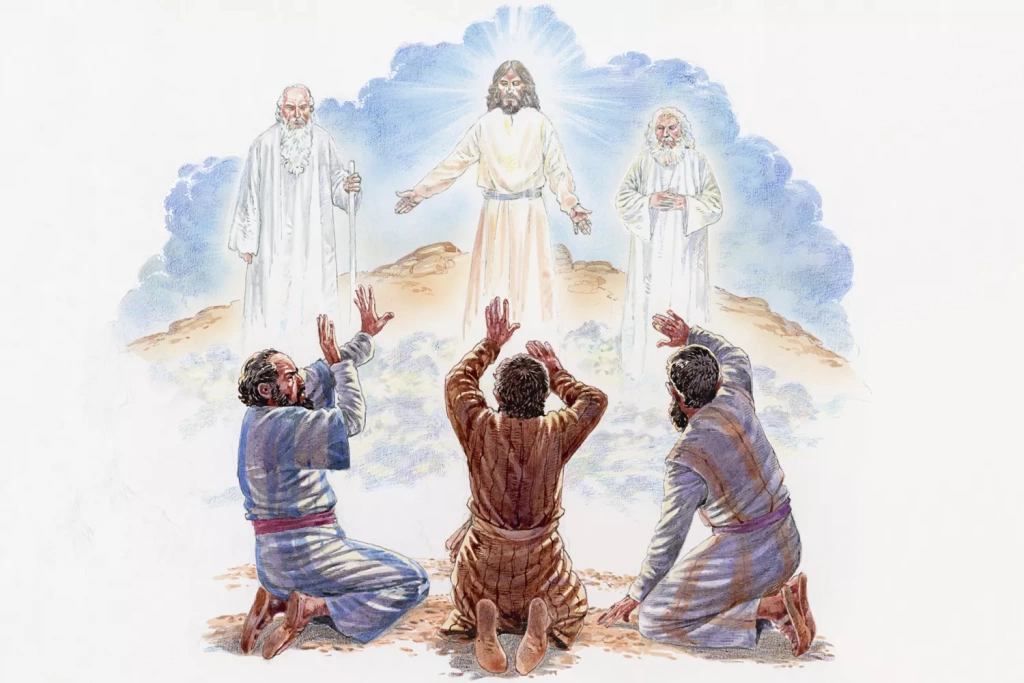
Elijah is one of the most important prophets of Israel who helped the Israelites stay faithful to Yahweh, and some believed that Elijah’s return would signal the coming of the Messiah for the Jewish people. The appearance of these two figures from Israel’s history indicated Jesus’ continuity with the Law and the prophets. They also reveal that Jesus is the fulfillment of all that was promised to the people of Israel.
Upon witnessing Jesus’ Transfiguration and seeing Jesus with Elijah and Moses, Peter offered to construct three tents for them. Then a voice from Heaven was heard affirming that Jesus is “my beloved Son” and commands the disciples to listen to him.
In each of the reports of the Transfiguration, Jesus instructed the disciples to keep what they had seen secret until after “the Son of Man has been raised from the dead.” Until they witnessed Jesus’ Passion and Death. The disciples could possibly not understand what he meant by being “raised from the dead.”
What happens to Jesus is exactly the template for what the Holy Spirit wants to do in each of us. In this respect, the Transfiguration of Jesus is a foreshadowing of our own resurrection—the divine glorification not just of our souls, but of our bodies as well (see CCC 556). The Transfiguration occurs right after Christ had predicted his passion. This teaches us that the suffering of the Cross culminates in triumphant glory and victory (see Matthew 16:21 and 17:1-5). So, why is the Transfiguration so crucial to our Christian faith? Because our Christian faith does not end with the Cross. It does not even end with Christ’s resurrection. What happened to Christ will also happen to us.
In the transfiguration, we see an anticipation of Jesus’ resurrection, a foreshadowing of Christ’s glory in Heaven, and the promise of our own resurrection. God’s plan is not only about redemption and forgiveness of sins but also to heal and transform our fallen nature—to make us radiate with his divinity.
What happened to the Head will happen to the entire Body of Christ. What we contemplate in the Transfiguration is a sign of God’s plan for each and every one us, to redeem and glorify each of us in soul and body. In the Eucharist, we participate in this heavenly reality, even now. May the Transfiguration of Jesus bring a transformation of our lives now and forever. Amen.
Fr. Stephen Kakande Sekayala C.S.Sp
St. Joseph Parish, Luquillo